

Agile Coaching Roles – Notes from Agile 2009 OpenJam

After a couple of Agile 2009 sessions on coaching I realized I was even more confused than ever about how to think about my work as an Agile Coach.  Arto Eskelinen and I decided to run an OpenJam to clarify this.  Thanks to: Lyssa Adkins, Tobias Mayer, Dave Nicolette,  Rachel Davies, Tim McCoy and David Fox.  (Sorry if I missed anyone.)

After brainstorming ideas, we were able to cluster them into three layers to reflect different logical levels.   Let’s go through them in turn.

Goal of Coaching
goal-of-coaching

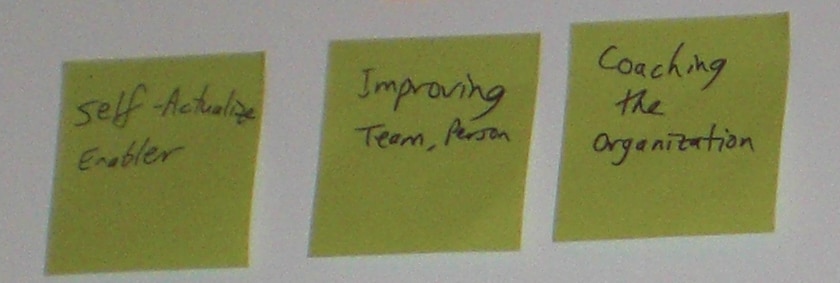
The first level is about what we hope accomplish by working with a client.  The primary purpose is to help the client to self-actualize – to move them forward on their journey towards reaching their potential.

Note that an engagement will involve three types of clients:

  • Individuals
  • Teams
  • Organization

(In this blog, I’ll talk generically about clients - it could be any of the three types.)

That’s a lot to do, so it’s important to choose…

Coaching Approach
consultative-approach1

Learning Models

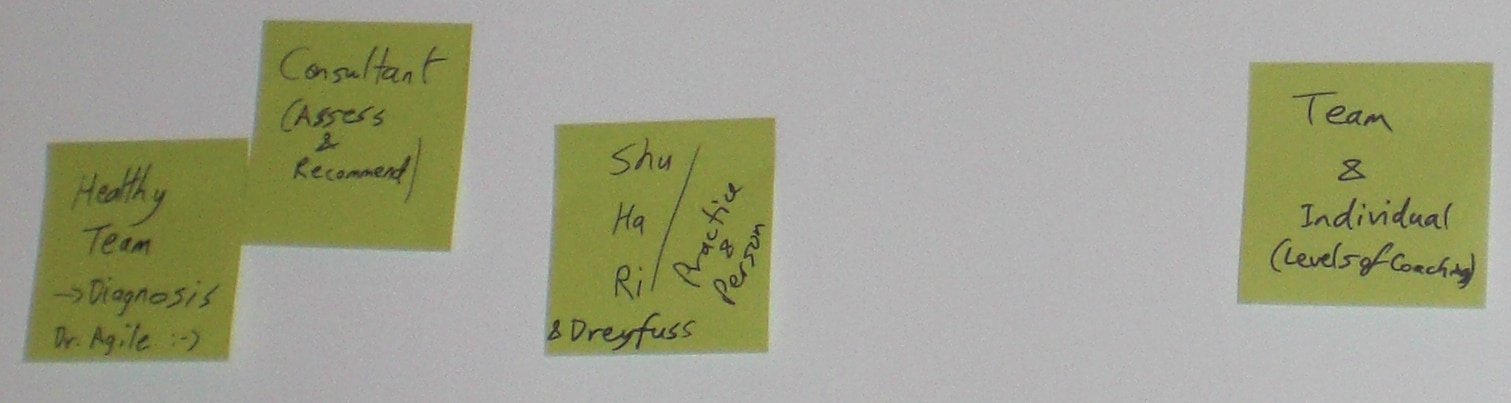
To be effective, it helps to understand where the client is in regard to a particular skill.  One model is Shu (Beginner) – Ha (Practicing) – Ri (Expert) that Allistair Cockburn talked about at the keynote.   Another variant of this is the Dreyfus Model of Skill Acquisition: Novice, Advanced Beginner, Competent, Proficient, and Expert.    The type of intervention we choose as a coach depends on the skill level of the client: a beginner may simply be taught, while a guiding and clarifying is needed when skill is higher.

Consultative Approach

We talked about understanding your client’s needs at any point in time.  The traditional approach from consulting is to assess the situation and make a recommendation.  The assessment could be a formal one or based on ongoing tacit knowledge.  Related to this is the goal of a healthy client (team).  As an Agile coach, one model is to diagnose problems and provide prescriptions/guidance.  This seems like common sense but kept coming up as a critical success factor.

Roles played by coaches
roles-we-play

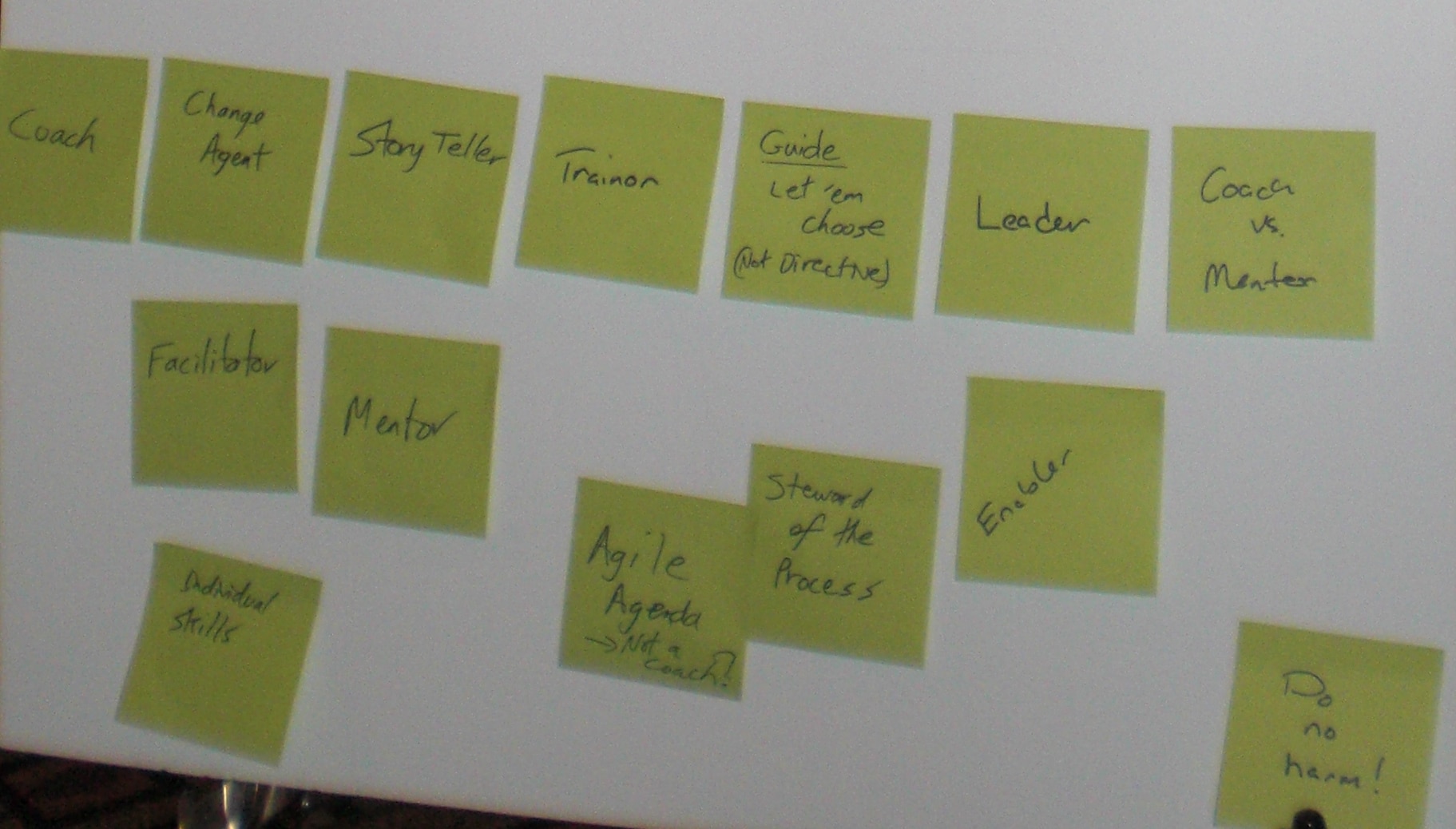
The above image indicates some of the roles that were identified (probably a bunch missing).   Here’s what came up:

  • Change Agent
  • Trainer
  • Story Teller
  • Guide
  • Leader
  • Mentor
  • Facilitator
  • Enabler

Agile Agenda?

One interesting comment was that an Agile coach has a specific agenda – adoption of Agile – that was in conflict with pure coaching.   Now that I have benefit of a few days to reflect, I this does not seem to be a conflict.  As an Agile Coach, if I don’t think a client will benefit from Agile, I won’t take them there.

Steward of the Process

Another role that I would like to call out separately is Steward of the Process.  I think it is probably true in many cases, but I find this a little alarming since as a coach I would like to leave one day and have my client succeed without me.  Perhaps as a transition plan, we need to find a new steward and then coach them to be successful in that role.

Do no harm

One final point to mention is do no harm!  We are there to make clients (individuals, teams, organization) successful, not to inflict Agile process and practices indiscriminately.  Even if we know something is really good, it might not be the right thing for this client at this point in time.

Related posts:

  1. Coaching Self-Organizing Teams Joseph Pelrine gave a really interesting session on “Coaching Self-Organizing...
  2. Ways to start with Agile – books, training, or coaching? I wrote this to help explain to the different types...
  3. Coaching and Producing Value David Hussman gave a great session on coaching called “Coaching...
  4. Munich 2009 Scrum Gathering Roundup I was really excited to see the presentations from the...
  5. Learn to coach and observe through play At DeepAgile in Boston, I played Yellow Brick Road: Fresh...

Related posts brought to you by Yet Another Related Posts Plugin.

6 Comments »

  • Lyssa Adkins Said,

    August 29, 2009 @ 4:58 pm

    Nice synopsis of the convo, Michael. I wasn’t able to stay long enough to hear the Shu-Ha-Ri part of the dialogue because I had an impending session to set up, but I wish I could have because the chapter I am currently writing in the Coaching Agile Teams book talks about coaching styles and how they change as a team goes through the Shu-Ha-Ri stages of evolution (and devolution). And, it also strikes me that the way the group thought about coaching is similar to how I structured the book (that’s lucky!): basically Coach as Facilitator, Teacher, etc. If anyone is interested, draft chapters of the book are at:

    http://www.mikecohnsignatureseries.com/books/coaching-agile-teams

  • Michael Sahota Said,

    August 29, 2009 @ 6:11 pm

    Thanks, Lyssa. Looking forward to the book. I’ve downloaded the public chapters and will let you know how they work for me.

  • Gil Broza Said,

    August 31, 2009 @ 9:47 pm

    Regarding the paragraph “Steward of the Process”:

    We must distinguish between an external, hired transition coach and an internal one. The internal one ought to be the steward of the process (and a bunch of other things). The external one, if brought in to guide Agile adoption, is only temporarily that. My model — with clients who see the value — is outcome-based, the outcome being Agile self-sufficiency. My evidence procedure is the exhibition of Agile principles and practices without my presence. A necessary part of that is to grow internal coaches, or shared leadership / stewardship of the process.

    Gil

  • Scott Duncan Said,

    September 1, 2009 @ 8:26 am

    I agree with Gil’s distinction between coaching as a member of the organization compared to being a person coming in from outside. Indeed, I’d suggest this applies broadly across a lot of the duties of a coach, not just process stewardship. An external coach may also have less time to achieve self-sufficiency goals than someone internally.

    One point that can be controversial is: “one model is to diagnose problems and provide prescriptions/guidance.” I know a common expectation in hiring a consultant is that they are being paid to being solutions and tell people what they know and how to do it. The coaching advice I heard in various sessions at Agile 2009 argued against a prescriptive stance. The general recommendation seemed to be to help individuals/teams/orgs diagnose their own issues and guide them to solutions. I think most Agile coaches advocate this approach, so I would tread lightly on use of the word “prescription” and its variations.

  • Svilen Dobrev Said,

    September 2, 2009 @ 2:48 pm

    i dont know if pure Agile Coach is possible… i mean, going to a place that wants to or can be _only_ improve process-wise… and never add something else, be it config.management or languages or technology or patterns or whatever-else software related. The way i see it so far, few companies really would make a difference agile or not – usualy there’s no real process / workflow of making software and decisions about it at all, some ad hock stuff that made it into “company policy”. And one finds hirself teaching basic sw engineering principles…

    i have not been and external coach (yet), but couple of times being internal… There are couple of issues.. some plus some minus. Worst might be that One may never have enough time to pay attention to coaching. Especially if the team/organisation needs much more hard measures for teaching how-to-do-software in general. Another thing is that being inside, one knows the people and relations _very_ well, but either cannot escape the “we” and look from outside, Or it is possible but difficult to achieve, and then even harder to explain to others how they look from outside – they won’t believe as u’re inside.

    One more role, esp. applicable to internal “enthusiast” coaching, is a Missionary (evangelist? dont like either word but cant find a better one). u have to sell the idea to people under and above you. AND make sure they understand the after-effects.
    For example telling some big manager that once the team gets self-control he won’t be able to kick as he used to before… OR telling some guy that from now on he will be freer but Responsible… might not be the easiest thing – they may just ignore it.

  • Michael Sahota Said,

    September 3, 2009 @ 2:27 pm

    Gil, Scott, Svilen – Thanks for your comments.

    Gil – Like the comments about evidence procedure.

    I would say that each and every team needs a “Steward of the Process” and that even an internal coach needs to grow someone into that role.

    Scott – I appreciate your comment about prescriptive changes. Out of habit we may treat people in the Shu phase when they are in the Ha phase. The whole point of this is that a coach may explicitly or implicitly decide what to focus on with a team/individual/organization. The change may be brought about through insightful questions or through teaching. This is independent of how we make an assessment.

    Svilen – Good point about the Missionary/Evangelist. I’d put this under “Change Agent”. Also, it’s good to keep in mind that Evangelists can sometimes be counter-productive.

  • Leave a Comment

    Powered by WP Hashcash


       Follow MichaelSahota on Twitter  
    
         XPToronto and Agile User Group
       Certified ScrumMaster Certification
       Certified Scrum Professional Certification