
Here are the slides and reference links for the session Gino Marckx and I are giving at Agile 2010 in August
Triangle Model
Selecting and delivering the most important work is a critical success factor in Agile projects. But how do you know what is important? Unless you are psychic, some help would come in handy. Consider the diagram below to help make sense of the wide variety of strategies and tools.
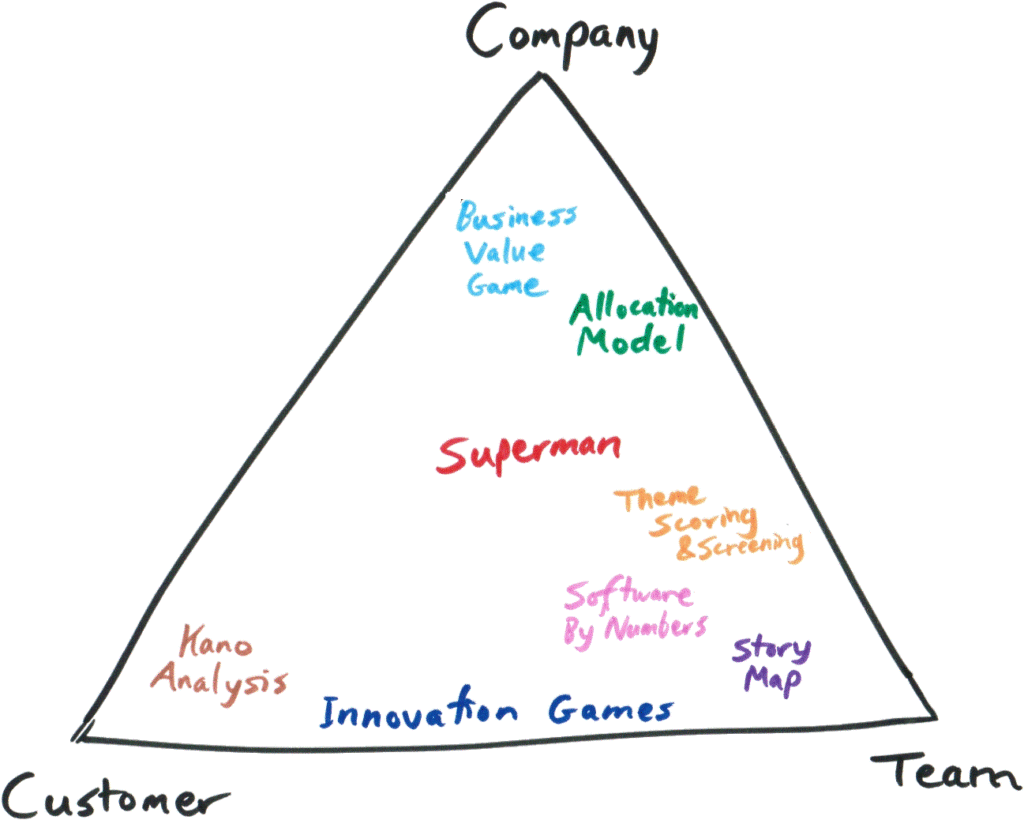
We explain three different perspectives: Company, Customer, Team.
Team Perspective
The product backlog needs to be structured so that it informs the team of the vision and the work. Whenever the company or the customer priorities are not clear, the team will need to rely on general information and it’s common sense.
Theme Scoring & Screening – Relative or numerical weighting based on criteria (Mike Cohn)
Story Map – structure the work in a grid that reflects actual product usage (Jeff Patton)
- Jeff Patton’s blog
- Presentation
Software By Numbers – prioritize work by Net Present Value of Minimum Marketable Feature
Customer Perspective
The product backlog prioritization is done from the customer’s perspective, from the perspective of whoever is paying for the product in the first place, whether this customer is internal or external to the company doesn’t really matter. What is most valuable to the customer will be on top. Techniques focussing of this view require strong product domain knowledge, and a good understanding of the impact of specific features on the business.
Kano Analysis – Structured Questionnaire to determine feature relevance: Mandatory, Linear, Exciter
- See materials of Mike Cohn from Team Perspective: Theme Scoring & Screening
Innovation Games® – 12 Games to better understand your product and what’s important (Luke Hohmann)
- For Speedboat® and Buy A Feature® + more – innovationgames.com and Book
Company Perspective
Companies need to find a balance in distributing the effort over multiple customers and/or products. But they also need to take the company and product strategies into account, deprioritizing features that might be very valuable for customers but aren’t in line with the company’s vision. As well, this takes into account stakeholders other than customers and sales – support, professional services, etc.
Company and Stakeholder Strategy
Business Value Game – Simulation to illustrate how organizations can define their own business value model.
- Game instructions
Allocation Model – helpful to balance priorities with divergent or competing interests
- See example by Alisson Vale: Slides 40-49
Where to go from here?
The most common questions we have gotten after presenting these techniques are “How do I decide where to start?” and “How do these work together?”
These are complementary techniques and are used to solve related problems. Our recommendation is to start with the area that is the biggest challenge for your project. Maybe this means talking to stakeholders you normally don’t talk to. Maybe it means putting a Story Map up on the wall. It depends.